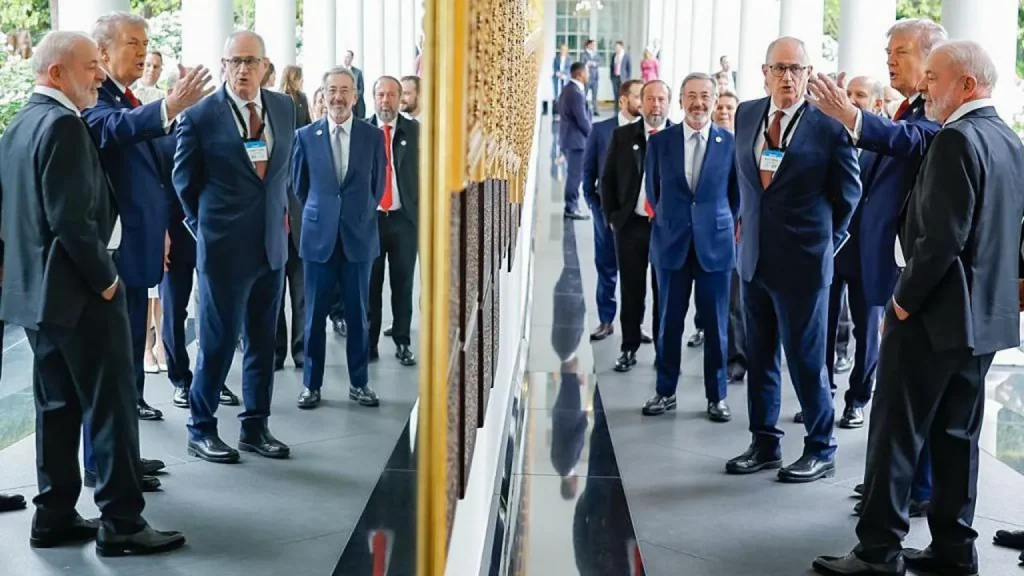
Despite the recent history of tension between Brazil and the United States, Presidents Luiz Inácio Lula da Silva and Donald Trump ended their meeting on Thursday at the White House exchanging public compliments.
Trump said in a post on Truth Social that the meeting had been “very good” and called Lula “dynamic”, while the Brazilian president said he left the meeting “very satisfied”.
Still, the absence of a joint Oval Office press appearance could be a a sign that important disagreements remain unresolved.
The two governments still disagree on key issues such as crime, and Lula acknowledged they are especially far apart on trade.
“He always thinks we charge too much tax,” Lula said of the leaders’ tariff discussions, saying Brazil had proposed a working group to negotiate any trade disagreements within 30 days.
“Whoever is wrong will give in. If we have to give in, we will. If you have to give in, then you will have to give in,” he said.
Washington and Brasilia have also faced strain over the fight against organised crime, the US’s war in Iran and the risk of American interference in Brazil’s October elections.
And Trump has pushed Lula to drop charges against former Brazilian President Jair Bolsonaro, who was last year convicted of an attempted coup and sentenced to 27 years in prison.
Trump usually relishes the opportunity to meet with foreign leaders at the White House, and often turns the visits into lengthy informal press conferences.
The White House’s decision on Thursday to forego a joint Oval Office appearance with Lula was telling, experts told the BBC, despite Trump’s assertions that the meeting went “well”.
Oliver Stuenkel, associate professor of international relations at Fundação Getulio Vargas (FGV) in São Paulo, said the lack of a joint statement during or after the meeting indicates that “some disagreements remain on the table”.
But that doesn’t mean the outcome of the meeting was negative, Stuenkel said.
Dawisson Belém Lopes, professor of International Relations at the Federal University of Minas Gerais, agreed. For him, the cordial reception given to Lula indicates a normalisation of the bilateral relationship after months of strain.
“I would be careful not to exaggerate or over-interpret this cancellation [of the Oval Office press appearance],” he said.
“Lula is treated as an important, respectable interlocutor. He was literally received with a red carpet and went there to discuss matters of state, regardless of the disagreements that may exist – and certainly do exist – between him and Trump,” he added.
Lopes said he believes the Thursday meeting marked a change in the White House’s strategy towards Brazil after months of tension and public confrontations.
“Trump is very experimental in the way he does politics in general, and foreign policy in particular. He operates by trial and error, and in this specific case he already tried confronting Lula and Brazil,” Lopes said. “It brought no kind of reward.”
According to Lopes, Washington has adopted a more pragmatic and less ideological approach to the bilateral relationship since September – when the two presidents met at the UN General Assembly in New York .
The meeting, held “away from the spotlight” would indicate precisely this change in tone, he said. “This meeting signals the arrival of a new moment in bilateral relations.”
Stuenkel, of FGV, said he believes the length of the meeting – around three hours – may indicate an effort to build a personal relationship between Trump and Lula – especially important in the Trump era.
The Brazilian government did not expect major immediate concessions from the American president anyway, Stuenkel said, especially on sensitive issues such as the US asking Brazil to classify certain groups as terrorist organisations.
“It was not realistic to convince Trump to reverse all the demands.”
The Brazilian strategy appears to have been more focused on reducing the risk of new friction points than on obtaining an immediate diplomatic victory.
“Perhaps it is neither so relevant nor so smart to seek a major victory… but simply to reduce the risk” of the US moving toward new disagreements, Stuenkel said.
Elections loom in both countries
In a “very delicate moment in the bilateral relationship,” avoiding any public tension between the two leaders is a win, Stuenkel said.
For Lopes, the proximity of elections in both Brazil and the United States means there is political interest on both sides in avoiding public friction.
Lula is seeking re-election in October and would want to ” avoid thorny issues and anything that could be used against him”, Lopes said, as Trump is facing his own domestic pressure ahead of the US midterms in November.
“It is in the interest of both parties not to create negative political facts and to manage the main points of contention,” Lopes said.
That may also be why certain sensitive topics were not dealt with directly by the presidents, Lopes said, speculating that the leaders avoided issues considered “unsolvable from the outset”.
“Trump is no longer a beginner at this point, much less Lula. Since these are experienced diplomats, experienced heads of state, they try to steer away from obstacles that are insurmountable.”
The meeting could ultimately be seen as a win for Lula, Lopes assessed, especially given the asymmetry of power between the two countries.
“The United States is more important to Brazil than Brazil is to the United States,” he said. “So in this case, if there was a draw, it is better for Brazil.”